T8 vs T12: How to Tell Them Apart and What to Replace Them With
T8 tubes are 1 inch across and T12 tubes 1.5 inches. How to tell them apart on site, what each draws in a real fixture, and how to retrofit both to LED.
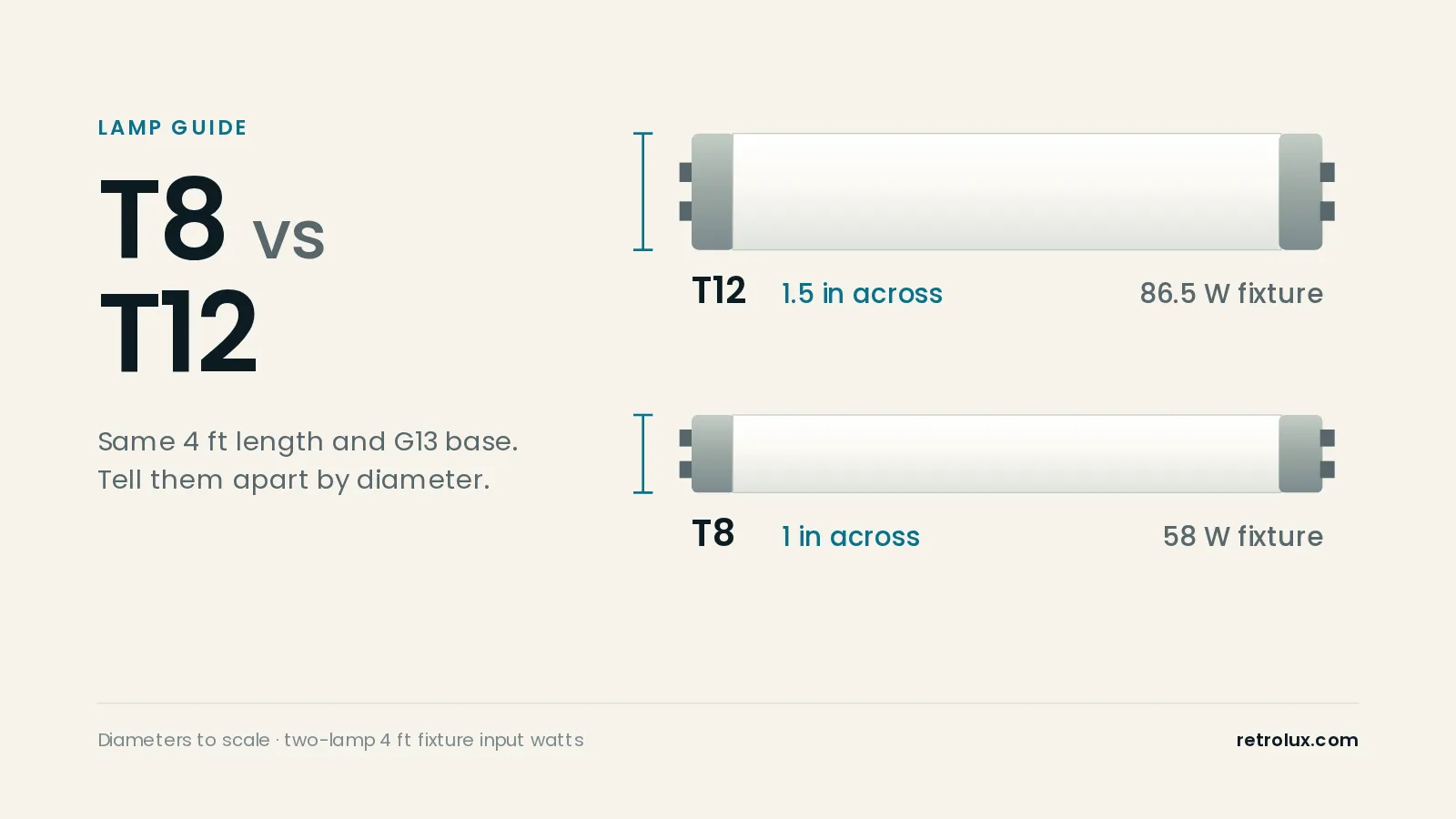
T8 and T12 are both linear fluorescent tubes. The difference is the diameter. A T8 is 1 inch across and a T12 is 1.5 inches. Common 4-foot T8 and T12 tubes share the same two-pin (G13) base and length, but they run on different ballasts. In a typical two-lamp 4-foot fixture, the T8 system draws about a third less power. Most T12 lamps haven’t been made since federal efficiency standards took effect in July 2012. A building still full of T12s is one of the easiest retrofits a contractor can justify.
What the T number means
The “T” stands for tubular, and the number is the tube’s diameter in eighths of an inch:
- T12: 12/8 inch, or 1.5 inches
- T8: 8/8 inch, or 1 inch
- T5: 5/8 inch
The code printed near the end of the lamp tells you the rest. In F40T12, F means fluorescent, 40 is the nominal wattage and T12 is the diameter. F32T8 is a 32 W, 1-inch tube. Both are 4 feet long.
T5 vs T8 vs T12 at a glance
| T12 | T8 | T5 | |
|---|---|---|---|
| Diameter | 1.5 in | 1 in | 5/8 in |
| Base | Medium bi-pin (G13) | Medium bi-pin (G13) | Miniature bi-pin (G5) |
| Common 4 ft lamps | F40T12 (40 W), F34T12 | F32T8 (32 W), 28 W, 25 W | F28T5 (28 W), F54T5HO |
| Usual ballast | Magnetic | Electronic | Electronic |
| Two-lamp fixture watts* | 86.5 W | 58 W | 64 W (F28T5) |
| Still made? | Mostly not since 2012 | Yes; sales banned in some states | Yes; sales banned in some states |
* Fixture input watts for two 4-foot lamps: T12 on an energy-saving magnetic ballast, T8 and T5 on electronic ballasts. Older standard magnetic ballasts, not made since 1990, draw 97 W with two F40T12 lamps.
Fixture input watts are from Xcel Energy’s rebate input wattage guide, which utilities and contractors use to estimate savings. Real fixtures vary with the ballast model and how the fixture is installed.
Two details matter on site. Input watts include the ballast, so a “40 W” tube does not mean a 40 W fixture. Two F40T12 lamps on an energy-saving magnetic ballast draw 86.5 W, not 80 W. And T5 is not a drop-in for either. Its smaller base won’t fit T8 or T12 sockets, so T5 shows up in newer fixtures rather than as a replacement tube.
How to tell a T8 from a T12 on site
- Read the lamp code. It is printed on the glass near one end: F40T12, F34T12, F32T8, F28T8 and so on.
- Measure the tube. A T12 is 1.5 inches across, a T8 1 inch. Next to each other, the T12 looks noticeably fatter.
- Read the ballast label. Take off the ballast cover and check which lamps the ballast is rated for and whether it is magnetic or electronic. The ballast decides what can go in the fixture, so this is the most useful of these checks.
- Notice how it starts. Magnetic ballasts, common with T12, often hum and can flicker or take a moment to start. Electronic ballasts start quickly and quietly. This is a hint, not proof.
Record the lamp code, the ballast type and the number of lamps per fixture on the audit, because the replacement options and the savings depend on them.
Why T12 lamps disappeared
Two federal Department of Energy (DOE) rules phased T12 out:
- Ballasts. A rule published in 2000 set efficiency standards for ballasts that run F40T12, F96T12 and F96T12HO lamps, which most magnetic ballasts couldn’t meet. It applied to ballasts made from April 1, 2005 and fixtures built from April 1, 2006, with replacement ballasts allowed until June 30, 2010.
- Lamps. Lamp efficacy standards rose for general service fluorescent lamps made on or after July 14, 2012 (10 CFR 430.32(n)). A 2012 DOE decision described them as standards that “effectively preclude the manufacture of T-12 GSFLs and the less-efficient models of T-8 GSFLs” (it then gave three manufacturers two more years for those T8s). As late as 2011, about half of US general service fluorescent sales were still T12s, according to figures cited in the same decision.
For an auditor, this means a magnetic T12 ballast still in service was almost certainly made before 2010, so it is more than 15 years old. The fixture uses more power than any common alternative, and replacement lamps and ballasts are getting hard to find.
T8 is now heading the same way. According to LEDVANCE’s state-by-state tracker, more than a dozen states have passed laws restricting the sale of fluorescent lamps. Bans on selling linear fluorescent tubes took effect in Vermont in 2024; in California, Colorado, Massachusetts, Nevada, Oregon and Rhode Island in 2025; and in Hawaii, Maine and Minnesota in 2026. Illinois follows on January 1, 2027 and Washington in 2029. A few other states, such as New Jersey and Maryland, ban only high color rendering tubes. The laws stop the sale of new tubes, often after a sell-through period, and exempt some specialty lamps. They don’t require anyone to remove existing fixtures, but once a ban takes hold, replacement tubes become hard or impossible to buy there.
Can you put T8 tubes in a T12 fixture?
Fluorescent T8 in a T12 fixture: the tube fits, because the base and length are the same, but it is not a good swap. Fluorescent lamps must match their ballast, and a T12 magnetic ballast is not designed to run T8 lamps. The result can be poor starting, flicker and short lamp life. The proper fluorescent upgrade was always to replace the ballast with a T8 electronic ballast and change the lamps together. With LED available, few projects do that anymore.
LED tubes in a T12 fixture: this is the usual retrofit today, and the tube type decides the wiring.
- Type A (plug and play) runs on the existing ballast. Most Type A tubes are made for T8 electronic ballasts and don’t work on old T12 magnetic ballasts. Keeping a ballast that is decades old in service is a poor bet anyway. Only use Type A where the ballast is on the tube maker’s compatibility list.
- Type B (ballast bypass) wires directly to line voltage, so the ballast comes out. This works in a T12 fixture regardless of the old ballast. A 4-foot LED tube sold as a “T8” fits the same G13 sockets; the rewire is what lets it run. Check whether the tube is single-ended or double-ended, because the socket wiring differs, and replace sockets that are brittle or cracked.
- Type C uses a separate LED driver in place of the ballast. It costs more and is less common in simple retrofits.
- Type A+B hybrids run on a compatible ballast now and on line voltage after a bypass later. Feit Electric, for example, says its Type B tubes work in most T8 and T12 fixtures after a ballast bypass.
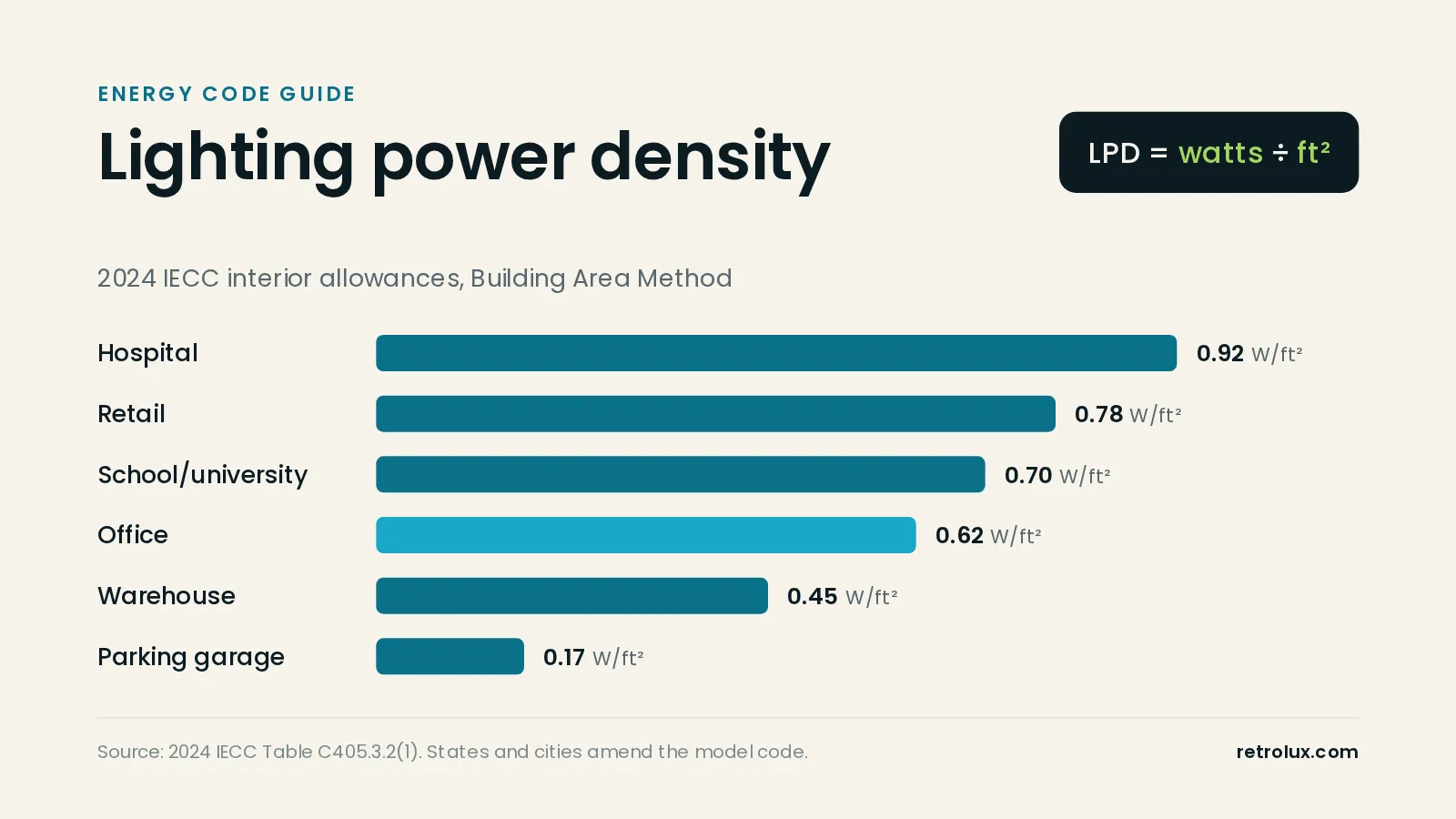
Rewiring a fixture for Type B is electrical work: turn off the circuit, follow the tube maker’s wiring diagram and apply the label that warns the next person the ballast has been bypassed. Some jurisdictions may treat a ballast bypass differently from a simple lamp change, which matters for energy code compliance; see when a retrofit has to meet lighting power density limits.
A full fixture replacement or an LED retrofit kit is the other route. It costs more per fixture than tubes, but it replaces the whole aging fixture, not just the light source, and often looks better.
Worked example: 100 two-lamp T12 troffers
A building has 100 two-lamp F40T12 troffers on energy-saving magnetic ballasts, running 3,000 hours a year. The LED tube wattage below is an example; use the spec sheet for the tubes you quote.
| Option | Watts per fixture | Total load | Energy per year |
|---|---|---|---|
| Existing T12 | 86.5 W | 8,650 W | 25,950 kWh |
| T8 lamps and electronic ballast | 58 W | 5,800 W | 17,400 kWh |
| Type B LED tubes, say 15 W each | 30 W | 3,000 W | 9,000 kWh |
The LED option cuts the load by about two-thirds and saves 16,950 kWh a year against the existing T12 system. At an electricity rate of $0.12/kWh, that is about $2,000 a year before maintenance savings and any utility rebate. Your rate and operating hours change the answer, which is why a proposal should use the customer’s.
To check the result against energy code, enter the fixture count, watts and floor area in our lighting power density calculator.
Common questions
Is T8 brighter than T12?
Not necessarily. Brightness depends on the specific lamps and ballast, so compare lumens on the spec sheets. The clear difference is power. In the Xcel figures above, a two-lamp T8 fixture on an electronic ballast draws 58 W. A two-lamp T12 fixture on an energy-saving magnetic ballast draws 86.5 W, so the T8 uses about 33% less. Much of that gap comes from the electronic ballast. The same guide lists two F40T12 lamps on an electronic ballast at 71 W.
Are T12 bulbs still sold?
Some remaining stock and exempt types are still around, but the 2012 federal standards stopped manufacture of most T12 general service lamps. Where you can still find them, buy them only to keep fixtures running until the retrofit.
Can I use a T12 LED tube?
Some LED tubes are sold as T12 size. Most 4-foot LED tubes are sold as T8, and after a ballast bypass a T8 LED tube fits a T12 fixture’s G13 sockets. What matters is the tube type (A, B, C or hybrid) and the wiring, not the diameter.
What should happen to the old fluorescent tubes?
Fluorescent lamps contain mercury, so they must be recycled or disposed of under the rules that apply where you work, not thrown in the trash. Our post on recycling regulations and resources covers the basics. For more on lamp types in general, see the lamps training module.