Lighting Power Density: Formula, Code Limits and a Calculator
What lighting power density means, how to calculate it, the 2021 and 2024 IECC limits for every building type, and when a lighting retrofit has to meet them.
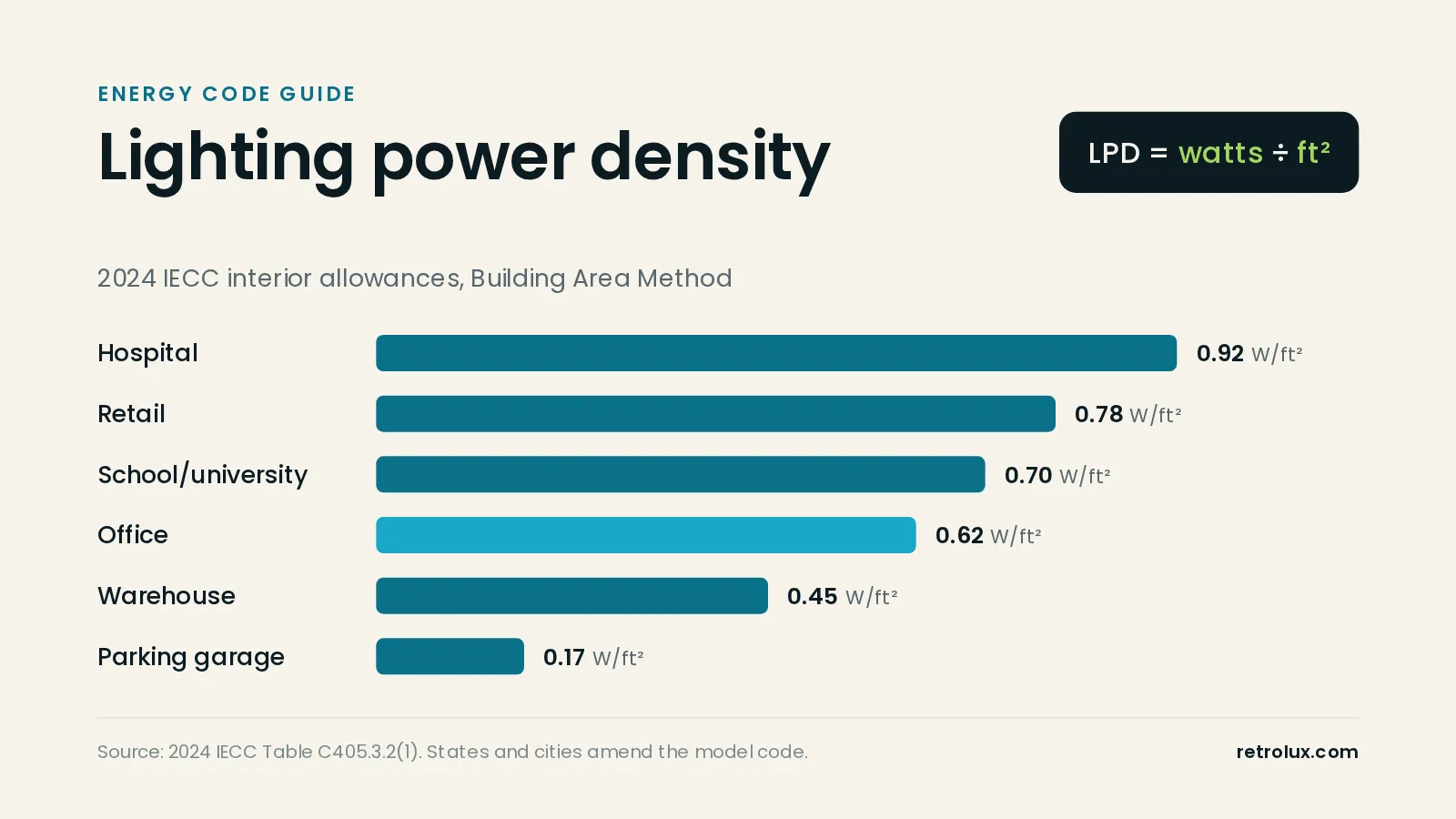
Lighting power density (LPD) is the lighting power installed in a space divided by its floor area. In the US it is measured in watts per square foot (W/ft²). Energy codes cap it. Under the Building Area Method of the 2024 International Energy Conservation Code (IECC), an office building is allowed 0.62 W/ft² of interior lighting and a warehouse 0.45 W/ft².
Contractors run into LPD in two places. Some retrofits have to prove they meet code, and every proposal is stronger when it shows the customer how far their existing system is from current practice. The calculator below does the arithmetic.
Lighting power density calculator
Building Area Method. Replace the example numbers with your project.
Leave out guest rooms, apartments and other sleeping or dwelling units; the code excludes their area and lighting. Hospital patient rooms count.
How to calculate lighting power density
LPD = total connected lighting power (watts) ÷ lighted floor area (ft²)
To convert to watts per square meter, multiply W/ft² by 10.76.
Connected power is each luminaire’s rated input wattage, not the lamp wattage. The IECC (Section C405.3.1) counts:
- LED luminaires: the rated wattage of the luminaire, whether the driver is integral or remote.
- Luminaires with a ballast or transformer: the rated input wattage of the ballast or transformer when operating that lamp.
- Line-voltage lamps wired directly to building power: the rated wattage of the lamp.
- Track and plug-in busway: the specified luminaire wattage but not less than 8 W per linear foot, or the limit of the current-limiting device or transformer that supplies it.
Some lighting is left out of the total, and the 2024 IECC lists 20 exclusions. Among them are exit signs, emergency lighting that is off during normal operation, lighting built into equipment by its manufacturer, lighting equipment for sale, task lighting for plant growth, and lighting in sleeping and dwelling units.
Sleeping and dwelling units come out of the floor area as well as the watts, so leave guest rooms, dormitory rooms and apartments out of the area you enter. Hospital patient rooms are the exception and still count. The excluded units have their own rule instead: permanently installed lighting must reach at least 65 lumens per watt for lamps or 45 lumens per watt for luminaires.
Worked example: an office retrofit
An 18,000 ft² office has 300 fluorescent troffers. Say each draws 85 W; check the ballast label or spec sheet for the real input wattage. The existing system is:
- 300 × 85 W = 25,500 W
- 25,500 W ÷ 18,000 ft² = 1.42 W/ft²
The proposed design replaces them with 300 LED troffers rated at 32 W:
- 300 × 32 W = 9,600 W
- 9,600 W ÷ 18,000 ft² = 0.53 W/ft²
The 2024 IECC allowance for an office is 0.62 W/ft² × 18,000 ft² = 11,160 W. The LED design comes in 1,560 W (14%) under it, while the fluorescent system draws more than twice the allowance. These are the calculator’s starting numbers, so you can change one input at a time and watch the result move.
Building Area Method vs Space-by-Space Method
The IECC gives two ways to work out the allowance.
Building Area Method. Pick the building area type, such as office, retail or warehouse, and multiply its LPD by the floor area. A building with several types, such as retail on the ground floor and offices above, adds up the allowance for each type. It is quick, which suits a whole-building retrofit.
Space-by-Space Method. Assign each space a type, such as enclosed office, open-plan office, corridor or storage room, multiply each space’s area by its own LPD, and add them up. A space counts as its own space when partitions reach at least 80% of the ceiling height. It takes longer but fits a building with mixed space types better, and the total often differs from the Building Area Method’s. In the 2024 IECC, an enclosed office is allowed 0.73 W/ft² and an open-plan office 0.56 W/ft².
The method isn’t always your choice. The code requires the Space-by-Space Method for projects that cover only part of a building and for buildings with unfinished spaces. So a retrofit of one floor or one tenant space uses Space-by-Space. The calculator on this page uses the Building Area Method, so treat its answer as a first check for those projects.
Lighting power density limits by building type
The 2024 IECC lowered most allowances by 1% to 8%. Convention centers, exercise centers, fire stations, libraries, manufacturing facilities and warehouses stayed the same, and three types went up: multiple-family, museum and transportation.
| Building area type | 2021 IECC | 2024 IECC | Change |
|---|---|---|---|
| Automotive facility | 0.75 | 0.73 | -3% |
| Convention center | 0.64 | 0.64 | Same |
| Courthouse | 0.79 | 0.75 | -5% |
| Dining: bar lounge/leisure | 0.80 | 0.74 | -8% |
| Dining: cafeteria/fast food | 0.76 | 0.70 | -8% |
| Dining: family | 0.71 | 0.65 | -8% |
| Dormitory | 0.53 | 0.52 | -2% |
| Exercise center | 0.72 | 0.72 | Same |
| Fire station | 0.56 | 0.56 | Same |
| Gymnasium | 0.76 | 0.75 | -1% |
| Health care clinic | 0.81 | 0.77 | -5% |
| Hospital | 0.96 | 0.92 | -4% |
| Hotel/Motel | 0.56 | 0.53 | -5% |
| Library | 0.83 | 0.83 | Same |
| Manufacturing facility | 0.82 | 0.82 | Same |
| Motion picture theater | 0.44 | 0.43 | -2% |
| Multiple-family | 0.45 | 0.46 | +2% |
| Museum | 0.55 | 0.56 | +2% |
| Office | 0.64 | 0.62 | -3% |
| Parking garage | 0.18 | 0.17 | -6% |
| Penitentiary | 0.69 | 0.65 | -6% |
| Performing arts theater | 0.84 | 0.82 | -2% |
| Police station | 0.66 | 0.62 | -6% |
| Post office | 0.65 | 0.64 | -2% |
| Religious building | 0.67 | 0.66 | -1% |
| Retail | 0.84 | 0.78 | -7% |
| School/university | 0.72 | 0.70 | -3% |
| Sports arena | 0.76 | 0.73 | -4% |
| Town hall | 0.69 | 0.67 | -3% |
| Transportation | 0.50 | 0.56 | +12% |
| Warehouse | 0.45 | 0.45 | Same |
| Workshop | 0.91 | 0.86 | -5% |
Neither the floor area nor the lighting of sleeping units and dwelling units is counted, except hospital patient rooms (2024 IECC Sections C405.3.2.1 and C405.3.3). The 2021 table carries similar footnotes for dormitories, fire stations, hospitals, hotels/motels and multiple-family buildings.
The table shows the model code. States and cities adopt an edition, sometimes years later, and often amend it, so check the code your jurisdiction enforces before you rely on a number. California is the main exception. It uses its own energy code, Title 24, Part 6, which has different allowances and methods. The IECC also lets commercial buildings comply through ASHRAE/IES Standard 90.1 instead, which has its own allowances in Table 9.5.1 that change from edition to edition.
When does a lighting retrofit have to meet LPD limits?
Existing buildings don’t have to meet the current LPD limits until an alteration or a change of occupancy triggers the code. In the 2024 IECC, three provisions decide it:
- Changing only lamps or ballasts is a repair, not an alteration. Section C504.2 treats replacing only the bulb, the ballast or both within existing luminaires as a repair. The condition is that the replacement does not increase the installed interior lighting power. Plug-and-play LED tubes that run on the existing ballast fit this wording, as long as the installed watts don’t go up. Ballast-bypass conversions rewire the fixture, so ask your code official how they treat them.
- Altering the lighting in a space brings that space under the code. Under Section C503.5.1, an interior space whose lighting is altered must meet the interior lighting power limits (C405.3). It must also meet the lighting controls requirements (C405.2) and pass functional testing of those controls (C408.3). Adding or moving full-height partitions has the same effect.
- A change of occupancy can trigger it with no lighting work at all. Section C505.2.4 covers a space that changes to a use with the same or a higher energy use intensity rank. Its lighting must then comply with the lighting section (C405). A warehouse becoming retail space is one example. The requirement doesn’t apply when the change covers less than 5,000 ft², or when the code official approves an analysis showing energy use won’t go up.
The second point matters most for retrofit quotes. A space where the luminaires are replaced has to meet the LPD limit. It also has to meet the controls rules for new construction, such as occupant sensing and daylight response, and controls can add more to the scope and cost than the LPD check.
Your code official decides whether a retrofit kit or a ballast-bypass tube conversion is an alteration or a repair. Local amendments can change any of this, so confirm with the authority having jurisdiction before you quote. This section follows the 2024 IECC. Earlier editions word the alteration rules differently, so check Chapter 5 of the edition your jurisdiction enforces.
Why LPD matters beyond compliance
- It is a quick sanity check on an audit. An office at 1.4 W/ft² has plenty of savings available. One already at 0.6 W/ft² probably has its LEDs, and the remaining savings are in controls and operating hours.
- It makes the proposal easier to explain. “Your lighting draws more than twice the power code allows a new office” is a sentence a facility manager can repeat to the people who approve the budget.
- Utility programs use the same idea. Some programs pay new construction and major renovation incentives based on how far a design comes in under the code allowance. Ask your utility how its program works.
Common questions
What is a good lighting power density for an office?
The 2024 IECC limit for a whole office building is 0.62 W/ft² (0.64 W/ft² in the 2021 IECC). The LED design in the example above lands at 0.53 W/ft², while the fluorescent system it replaces is at 1.42 W/ft², more than twice the limit.
Does LPD include exit signs and emergency lighting?
No. Exit signs are excluded, and so is emergency lighting that is automatically off during normal building operation. Emergency fixtures that also run as normal lighting count.
Is lighting power density the same as lighting power allowance?
No, but one comes from the other. LPD is a rate in watts per square foot. The lighting power allowance is the total watts the code permits, which is the LPD for the building or space type multiplied by its floor area. Your design passes when its connected lighting power is not greater than the allowance.
Where do these numbers come from?
The building area values are from IECC Table C405.3.2(1). We took the 2021 values from the U.S. Department of Energy’s Building Energy Codes Program and the 2024 values from the 2024 IECC table. We then checked ten building types in each edition against the University of Illinois Smart Energy Design Assistance Center comparison of the two editions.
For more on the site visit that feeds these numbers, see ten tips for a better lighting audit and the auditing training module.